New! DIY Project Planner. Plan smarter, skip the spreadsheets. Start Your Free Trial Today →

Smart DIY & Home Improvement Tips
Smart DIY & Home Improvement Tips
Get 2026 estimates to retile a bathroom: average cost, per‑sq‑ft ranges, labor vs. materials, shower/backsplash pricing, and money‑saving tips.
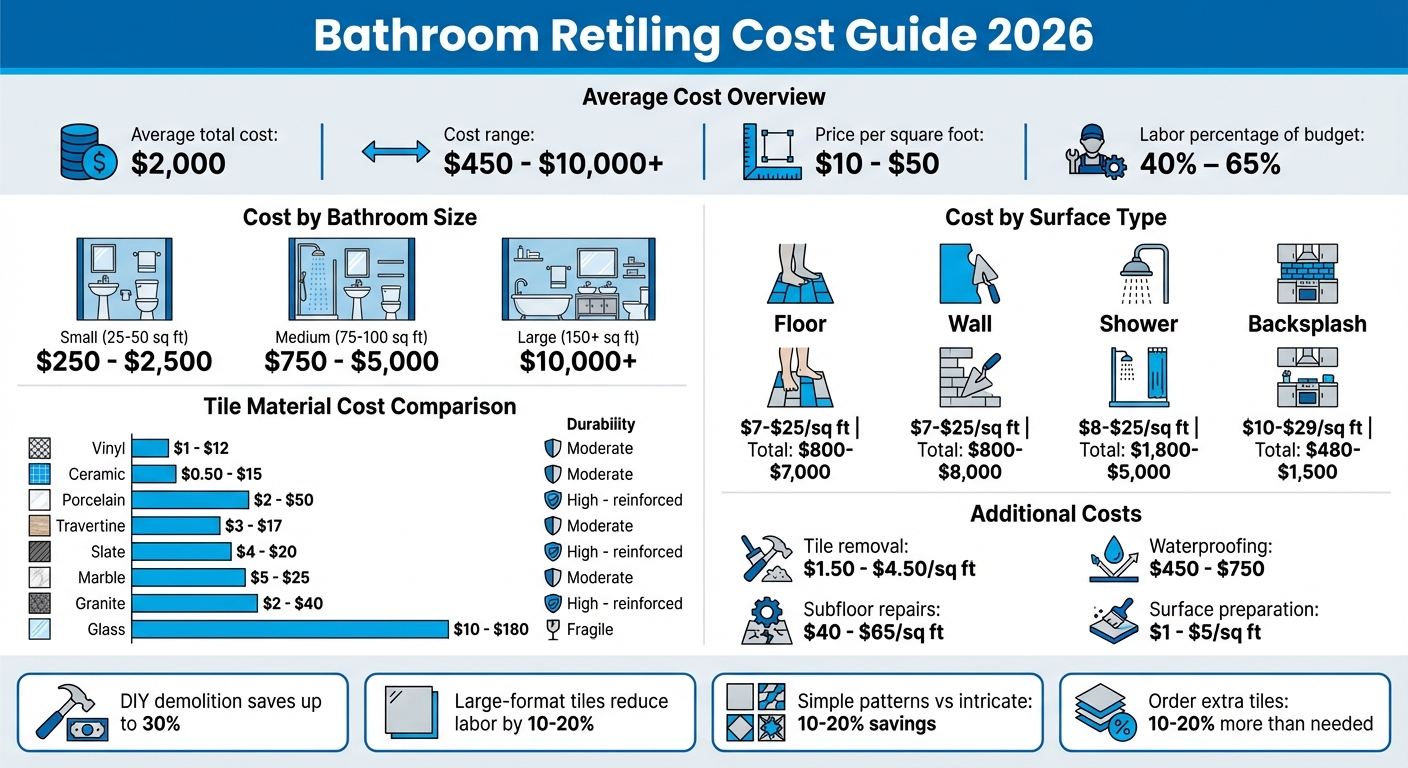
Retiling a bathroom in 2026 typically costs between $450 and $2,000 for smaller projects, while larger renovations can exceed $10,000. On average, homeowners spend $2,000, with prices ranging from $10 to $50 per square foot depending on materials, labor, and project size.
For cost savings:
Retiling showers and backsplashes costs more due to waterproofing and precision work, with showers averaging $1,800–$5,000 and backsplashes $480–$1,500.
Plan ahead by getting multiple quotes, ordering extra tiles (10%–20%), and scheduling during off-peak times to avoid delays and save money.
Bathroom Retiling Cost Breakdown by Size, Materials, and Surface Type 2026
On average, homeowners in the U.S. spend around $2,000 to retile their bathrooms. Costs can range from as low as $450 for smaller projects to over $10,000 for high-end renovations, with an average of $12.50 per square foot. The final price depends on factors like the size of your bathroom, the materials you select, and local labor rates. For projects that include both materials and labor, prices typically fall between $10 and $50 per square foot. Renato Vieira Mageste, Owner of Stars and Stripes Services, LLC, sheds light on this:
"Usually, you can expect to pay between $5 and $15 per square foot for basic tile installation, including labor and materials. High-end tiles like marble or custom options can increase the cost from $15 to $30 per square foot".
The size of your bathroom is one of the biggest factors influencing these costs.
Choosing budget-friendly materials can help keep costs lower, while premium upgrades will push the price higher.
Beyond size, other factors like design complexity and location also play a major role in determining the total expense.
Bathrooms with irregular layouts often require more precise tile cutting and additional labor, which increases costs. Similarly, bathrooms located on upper floors or in hard-to-reach areas tend to incur higher labor charges.
Labor rates also vary widely depending on where you live. In urban areas, rates can range from $30 to $120 per hour, while they are generally lower in rural regions. The complexity of your tile pattern is another key factor – straight-set designs are more affordable, but intricate patterns like herringbone or mosaics can increase installation costs by 10% to 20%. Additionally, unexpected issues such as water damage or uneven subfloors can add $40 to $65 per square foot.
When budgeting for your retiling project, it’s important to consider not only the size of your bathroom but also the layout, design preferences, and local market conditions to get an accurate estimate.
Your choice of tile can have a big impact on your budget. Tile materials range from as little as $0.50 per square foot for basic ceramic to as much as $180 per square foot for high-end glass tiles. Knowing the differences between tile types can help you find the right balance between cost, durability, and maintenance. Below is a quick comparison of popular tile materials to help you decide.
| Tile Material | Material Cost (per sq. ft.) | Durability | Maintenance Needs | Best Use |
|---|---|---|---|---|
| Vinyl | $1–$12 | Moderate | Low | Affordable flooring |
| Ceramic | $0.50–$15 | Moderate | Low | Walls, low-traffic floors |
| Porcelain | $2–$50 | High | Low | Floors, showers, high-traffic areas |
| Travertine | $3–$17 | Moderate | High (Porous) | Floors, walls |
| Slate | $4–$20 | High | Moderate | Floors, rustic designs |
| Marble | $5–$25 | Moderate | High (Requires sealing) | Vanities, accent walls |
| Granite | $2–$40 | High | Moderate (Requires sealing) | Floors, countertops |
| Glass | $10–$180 | Fragile | Low (Mold-resistant) | Backsplashes, accents |
Ceramic tiles are the most affordable option. Porcelain, while slightly more expensive, is fired at higher temperatures, making it denser and more resistant to moisture and stains. This makes porcelain a great choice for areas like bathroom floors and showers where water exposure is frequent.
For a more luxurious look, natural stone tiles like marble and granite can elevate your space and even increase your home’s resale value. However, they do require annual sealing to protect against water damage. Vinyl, on the other hand, is an economical choice that’s easy to install, though it doesn’t last as long as clay-based tiles. Glass tiles, while visually stunning and mold-resistant, are best suited for backsplashes and accents due to their fragility and higher cost.
With this comparison in mind, you can weigh the pros and cons of each material to select the best tile for your bathroom.
Once you’ve compared costs and durability, focus on performance ratings and safety features. Look for the PEI rating – Class I is suitable for walls, while Class IV or V is better for high-traffic floors. For wet areas like bathrooms, choose tiles with low porosity (less than 0.5% moisture absorption). For bathroom floors, matte finishes are a safer option since glossy tiles can become slippery when wet.
If you’re considering natural stone, remember to budget for annual sealing, which typically costs $6 to $15 per square foot, compared to $4 to $8 for standard ceramic installations.
To save on labor costs, opt for larger tiles, such as 12×12 or 12×24 inches. These install faster than smaller mosaic or subway tiles and have fewer grout lines, making them easier to clean. It’s also a good idea to order 10% to 20% more tile than your actual square footage to account for breakage, cutting errors, and future repairs.
Labor typically accounts for around 30% of your total retiling budget. Understanding how contractors price their work and what drives labor costs can help you avoid unexpected expenses.
Just like material costs, labor rates significantly influence your overall expenses. Contractors generally use one of three pricing methods: per-square-foot rates, hourly charges, or flat daily rates [4, 11, 14]. For most bathroom projects, per-square-foot pricing is the go-to method due to its straightforward calculation [8, 14]. Labor costs for ceramic or porcelain tile installations typically range from $3 to $15 per square foot [4, 11]. Hourly rates, on the other hand, vary between $30 and $120 per hour [4, 11]. For larger, multi-day projects, contractors may offer a daily rate [14, 16].
If you’re considering natural stone tiles, be prepared for higher labor costs. These installations require specialized skills and cost between $6 and $15 per square foot, compared to $4 to $8 per square foot for ceramic or porcelain. A professional tiler can usually cover 86 to 129 square feet of flooring per day, though full projects often take 2–3 days to account for curing time [4, 8].
Several variables can drive up labor expenses. Tile removal and subfloor repairs, for example, can add notable per-square-foot costs [4, 8, 11]. Surface preparation and cleaning often add an additional $1 to $5 per square foot.
The complexity of your tile pattern also plays a role. Intricate designs, such as diagonal or herringbone patterns, can increase labor costs by 10% to 20% compared to straightforward layouts [4, 8]. Similarly, smaller mosaic tiles require more time due to the increased number of cuts and grout lines [4, 14]. Bathrooms with unusual layouts, tight corners, or curved walls demand custom tile trimming, which can further raise costs [8, 11]. Accessibility issues, such as working in cramped spaces, may also lead to higher pricing.
"Usually, you can expect to pay between $5 and $15 per square foot for basic tile installation, including labor and materials. High-end tiles like marble or custom options can increase the cost from $15 to $30 per square foot."
– Renato Vieira Mageste, Owner of Stars and Stripes Services, LLC
To manage labor costs, consider requesting itemized quotes that separate charges for removal, preparation, and installation [15, 16]. You could also cut expenses by handling demolition yourself, opting for larger tiles that install more quickly, and sticking to your current bathroom layout to avoid costly plumbing or electrical adjustments [4, 8, 16].
Let’s dive deeper into how the type of bathroom surface impacts retiling costs. Each surface comes with its own price range, influenced by the materials used and the complexity of installation.
Retiling bathroom floors typically costs between $7 and $25 per square foot, with total project costs ranging from $800 to $7,000. On the other hand, wall retiling has similar per-square-foot costs but can total anywhere from $800 to $8,000 depending on the scope of the project and the materials chosen.
Floor tile installation is often more straightforward since it involves flat, horizontal surfaces. Larger tiles can also speed up the process, which helps reduce labor costs. However, floor tiles need to be more durable and slip-resistant, often rated Class III to IV on the PEI scale, to withstand foot traffic and prevent accidents. In contrast, wall tiles are typically thinner, more decorative, and rated Class I, as they don’t face the same wear and tear.
Installing wall tiles comes with its own challenges, requiring specialized adhesives to ensure they stay in place on vertical surfaces. The added complexity of wall installations can sometimes make them pricier despite covering less ground. Now, let’s look at how retiling showers and backsplashes can further affect your budget.
Showers are among the most expensive areas to retile, with costs ranging from $8 to $25 per square foot and total project expenses falling between $1,800 and $5,000. This higher price is due to the precision required for tasks like cutting tiles around plumbing fixtures and implementing waterproofing measures. Waterproofing alone can add $450 to $750 to your budget. If a new shower pan is needed, this could cost an additional $530 to $2,700. Labor costs are significant for shower projects, often making up 40% to 60% of the total price. This is because tasks like creating proper drainage slopes and installing waterproof membranes demand both expertise and time.
Backsplashes, while smaller in size, can be surprisingly costly. They typically range from $10 to $29 per square foot, with total project costs averaging between $480 and $1,500. As Emily McNiller, a content writer at homeyou, points out:
"Small areas like backsplashes cost more per square foot, while large projects offer better value overall."
Here’s a quick breakdown of costs by surface type:
| Surface Type | Cost per Square Foot | Average Total Project Cost |
|---|---|---|
| Bathroom Floor | $7–$25 | $800–$7,000 |
| Bathroom Wall | $7–$25 | $800–$8,000 |
| Shower | $8–$25 | $1,800–$5,000 |
| Backsplash | $10–$29 | $480–$1,500 |
Retiling your bathroom doesn’t have to break the bank. With careful planning and smart decisions, you can achieve a stylish, durable finish without overspending.
One of the quickest ways to cut costs is by taking on some of the work yourself. For example, DIY efforts can save you up to 30% on your project. Even if you’re not ready to handle the entire installation, you can still manage tasks like demolition – removing old tiles and flooring on your own can help reduce labor costs significantly.
If you’re new to tiling, start with smaller, less complex projects like backsplashes or laundry room floors. However, when it comes to areas like showers, it’s best to leave the work to professionals because proper waterproofing is crucial.
For tools, renting can be a cost-effective option. A wet tile saw, which is essential for cutting tiles, can be rented for $20–$70 per day – far more affordable than buying one outright, which can cost between $200 and $900.
The materials you choose play a big role in your overall budget. Glazed ceramic tiles are a great option, offering both durability and affordability at $0.50 to $15 per square foot. In contrast, glass tiles can range from $10 to $180 per square foot, meaning you could save $6 to $25 or more per square foot by opting for ceramic.
Large-format tiles – those 12×12 inches or larger – are another budget-friendly choice. They’re quicker to install and require less grout, cutting labor costs by 10% to 20%. For patterns, stick to simple layouts like "straight set" or "running bond", as intricate designs such as herringbone or mosaic can increase labor expenses by 10% to 20%.
Want a high-end look without the hefty price tag? Wood-look porcelain tiles, priced at $3 to $12 per square foot, can give your bathroom a luxurious feel. Another clever way to save is by using affordable ceramic tiles for most of the space while reserving pricier materials like glass or stone for small accent areas such as borders or niches.
Timing can make a big difference when it comes to saving money on retiling. Look for sales or discontinued tile lines to score quality materials at discounted prices.
Gil Gacuma of Sweeten offers this tip:
"Consider purchasing materials in bulk or during off-season sales to save money."
Before your contractor begins, make sure all materials are on-site and checked for quality. The Tile Shop emphasizes:
"It is also always best to have all of your materials on site before the project starts. Projected shipping deadlines might get pushed back, and it will always be more expensive to pause a project and resume it later."
Lastly, get at least three quotes from contractors to compare prices. Labor rates often vary by season, so scheduling your project during slower times can help you lock in better deals.
When it comes to retiling your bathroom, the size of the space, the type of tiles you choose, and the complexity of the labor involved are the biggest factors influencing costs. Projects can vary widely depending on these elements, and installation typically takes about three to five days to complete.
To stick to your budget, start by gathering at least three quotes from contractors. This will give you a better sense of labor rates and timelines. For basic installations, labor costs generally range from $3 to $15 per square foot, but if you’re opting for premium finishes, that number can climb to $30 per square foot.
Be prepared for unexpected expenses. For example, issues like water damage or subfloor repairs can add $40 to $65 per square foot to your total costs. Also, be sure to order 10% to 15% more tile than you think you’ll need. This extra tile will cover any breakage or necessary cuts during the installation process.
Here’s some good news: a midrange bathroom remodel typically recoups about 70% of its value, making it a smart investment for 2026. By following these cost-saving tips, you can create a bathroom that’s both beautiful and functional – without breaking the bank.
Before the work begins, double-check that all materials have arrived on-site to avoid delays. Inspect your tiles to ensure they’re damage-free and from matching dye lots, as mismatched tiles can lead to frustrating mid-project setbacks.
If you’re searching for a wallet-friendly way to retile your bathroom, vinyl tiles are one of the most affordable options, with prices ranging from $1 to $15 per square foot. Another economical choice is ceramic tiles, which usually cost between $4 and $15 per square foot. Vinyl tends to be less expensive, but ceramic provides a more classic aesthetic and better durability.
To stretch your budget further, keep an eye out for sales or check clearance sections for discounted tiles. Don’t forget to include installation costs and any extra materials in your overall budget planning.
To cut down on labor costs when retiling your bathroom, think about tackling some of the prep work yourself. Tasks like removing old tiles or cleaning and leveling the surface can make the job quicker and easier for a professional, which means lower costs for you.
Opting for standard-sized tiles and straightforward patterns can also make the installation process faster, reducing labor charges. Another way to save is by bundling your tiling project with other bathroom updates, which can help streamline the work and minimize overall labor hours. Clear planning and open communication with your contractor are key to avoiding extra expenses and sticking to your budget.
When you’re budgeting for retiling your bathroom, it’s important to factor in a few key elements. Start with the size of the space – larger bathrooms will naturally require more materials and labor. Then, think about the type and quality of tiles you want, whether it’s ceramic, porcelain, or natural stone. Each option comes with its own price range and durability. Don’t overlook labor costs, which can vary depending on where you live and how complex the job is.
Beyond the basics, there are other potential expenses to keep in mind. For example, you might need to pay for removing old tiles, addressing subfloor repairs, or adding waterproofing layers to ensure the final result is long-lasting and reliable.
Looking to save some cash? Compare prices across different tile options, explore budget-friendly alternatives, and, if you’re up for it, tackle smaller tasks like demolition on your own. A little planning and research upfront can go a long way in helping you avoid surprise expenses and stick to your budget.