New! DIY Project Planner. Plan smarter, skip the spreadsheets. Start Your Free Trial Today →

Smart DIY & Home Improvement Tips
Smart DIY & Home Improvement Tips
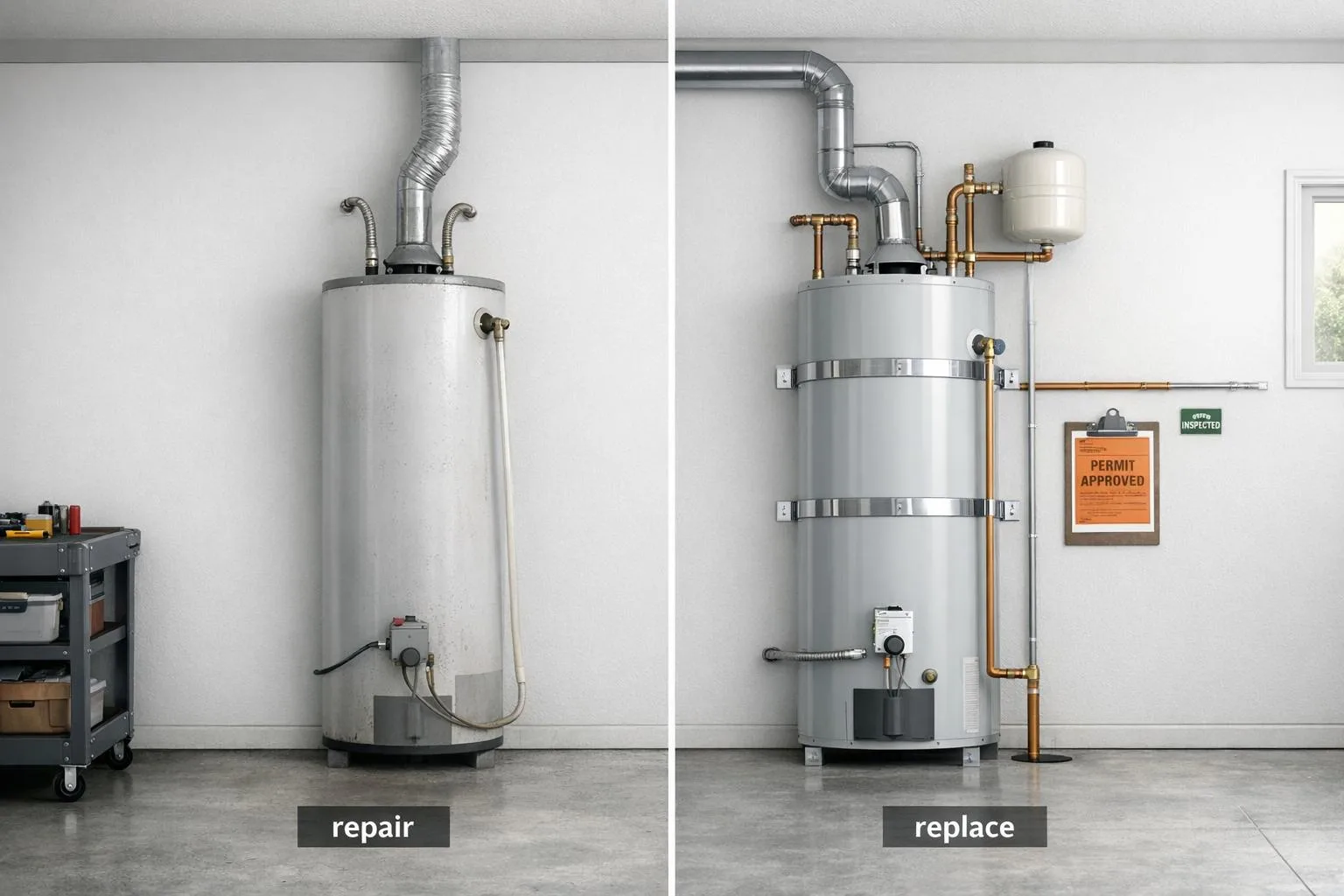
Learn when repairs can stay like‑for‑like and when replacements trigger modern codes, permits, inspections, and ordinance insurance limits.
When deciding whether to repair or replace parts of your home, understanding code compliance is critical. Building codes ensure safety and dictate when upgrades are required, especially during major repairs or replacements. Here’s what you need to know:
Key takeaway: Repairs are simpler and less regulated, but replacements demand strict adherence to updated codes. Always check local requirements to avoid fines or failed inspections.
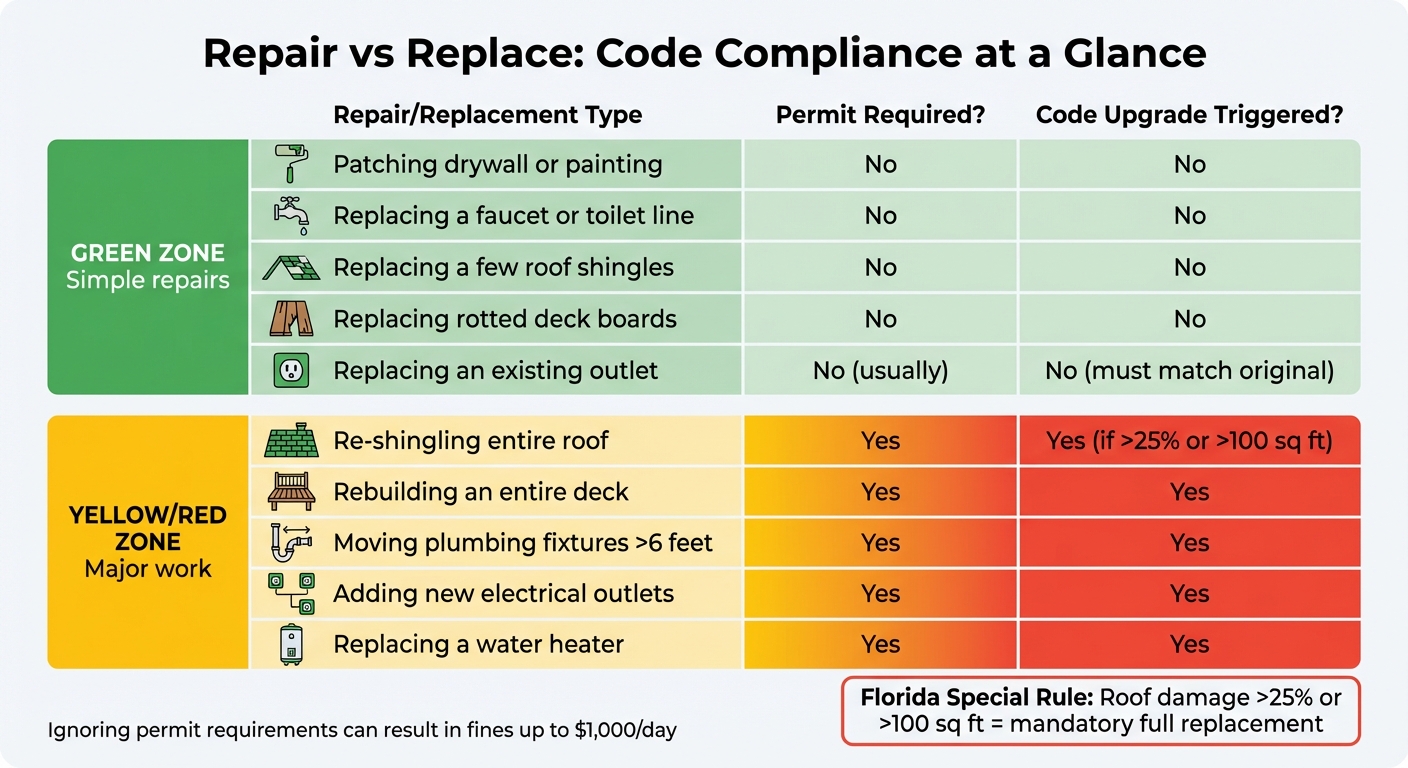
Home Repair vs Replacement: Permit and Code Compliance Requirements
Most routine repairs don’t require a permit or adherence to updated building codes. According to the State Building Code, these are considered maintenance tasks that don’t alter structural integrity, fire safety, egress, or major utilities. This allows homeowners to tackle many everyday fixes without the need to modernize their entire property.
Like-for-like replacements are a key exception. If you repair or replace something using materials and specifications similar to the original, you’re maintaining your home’s compliance. For example, replacing a broken electrical outlet with an identical one, installing a new faucet, or patching drywall won’t trigger code updates. However, materials banned under current codes can’t be used, even if they were part of the original installation.
Here’s a closer look at common repairs that typically stay below the code upgrade threshold.
In Florida, specific rules apply to roofing. If more than 25% of your roof is damaged, or if the damage exceeds 100 square feet, a full replacement is mandatory. These thresholds aren’t negotiable – once they’re crossed, you must replace the roof rather than repair it.
| Repair Scope | Permit Required? | Code Upgrade Triggered? |
|---|---|---|
| Patching drywall or painting | No | No |
| Replacing a faucet or toilet line | No | No |
| Replacing a few roof shingles | No | No |
| Replacing rotted deck boards | No | No |
| Replacing an existing outlet | No (usually) | No (must match original) |
| Re-shingling an entire roof | Yes | Yes (if >25% or >100 sq ft) |
| Rebuilding an entire deck | Yes | Yes |
| Moving plumbing fixtures >6 feet | Yes | Yes |
| Adding new electrical outlets | Yes | Yes |
| Replacing a water heater | Yes | Yes |
If you’re unsure whether your repair qualifies as minor work, it’s always a good idea to check with your local Department of Municipal Inspections. Ignoring permit requirements can result in fines of up to $1,000 per day, and unpermitted work may also void your homeowner’s insurance.
When it comes to replacement projects, the rules are stricter than for minor repairs. If you’re swapping out an entire home system or component, you’ll need to ensure it meets current building codes – even if the original installation dates back decades. For instance, if you’re replacing a water heater, furnace, or roof, the new installation must align with modern safety and efficiency standards, not the outdated rules from when your home was first built.
Replacement materials and systems must also comply with updated construction standards. For example, a new toilet must adhere to the 1.6-gallon-per-flush limit. Similarly, replacing an air conditioning unit in states like California means meeting a minimum efficiency rating of 15 SEER as of 2023.
Certain home upgrades consistently trigger updated compliance requirements. For example, HVAC system replacements must align with current efficiency and sizing standards. Ductwork, in particular, needs to meet insulation requirements – typically R-6 or R-8, depending on your climate zone – and must maintain at least a 1-hour fire resistance when passing through fire-rated walls.
Replacing water heaters usually requires plumbing permits and must follow updated venting, safety, and efficiency standards. Roof replacements, on the other hand, must be designed to handle wind, snow, and seismic loads specific to your location. In some areas, like Portland, reroofing may not require a permit if the replacement material matches the original weight – unless you’re in wildfire zones or working on townhouses. For structures exceeding 200 square feet or standing taller than 15 feet, building permits are typically required.
Electrical upgrades, such as replacing a fuse box with circuit breakers or adding new hard-wired fixtures, require an electrical permit and must comply with NFPA 70 standards. Additionally, modern codes often call for safety updates during these projects, like installing carbon monoxide detectors in sleeping areas.
"Permits issued by the Department of Buildings help to ensure construction work complies with the minimum standards of safety established by the Chicago Construction Codes in order to protect public health, safety, and welfare." – Department of Buildings, City of Chicago
Permits are essential for ensuring that work meets minimum safety standards. Skipping permits can lead to hefty fines and may even affect your homeowner’s insurance coverage.
Make sure to consult your local building department’s website or permit guide to determine which trade permits – mechanical, electrical, plumbing, or building – are required for your project. Reviewing local codes will also help you fully understand the necessary permits for your replacement project.
When deciding between repairing or replacing parts of your home, insurance coverage can play a big role, especially when it comes to handling costs associated with code upgrades.
Most standard homeowners insurance policies won’t pay for the additional costs required to bring your home up to current building codes. These policies typically aim to restore your property to its pre-loss condition using similar materials, viewing code upgrades as an improvement rather than a necessity.
If you want coverage for code-related expenses, you’ll need to add a specific policy endorsement called "Ordinance or Law" coverage. This add-on, which comes with a small additional premium, helps cover the extra construction costs required to meet current codes. Coverage limits are generally capped at 10%, 25%, or 30% of your dwelling’s coverage limit (Coverage A).
"Unless there is language in your policy covering additional costs associated with those changes, you may incur expenses to rebuild in compliance with present codes. Such coverage appears as an ‘endorsement’ – that is, as an option for ‘ordinance or law’ coverage – for a small additional premium." – California Department of Insurance
To find out if you already have this protection, review your policy’s declarations page under the "Additional Coverages" section. If you’re filing a claim, ask for a detailed, line-item estimate that separates code upgrade costs from regular repair costs. This can help streamline the claims process and avoid disputes.
| Scenario | Code Upgrade Triggered? | Policy Coverage | Ordinance or Law Endorsement Coverage |
|---|---|---|---|
| Minor Roof Patch | No | Covers shingles/labor only | Not applicable (no upgrade required) |
| Electrical Fire Repair | Yes (e.g., AFCI breakers) | Covers original wiring style only | Covers cost of new code-compliant breakers/wiring |
| Major Repair (Permit Required) | Yes | Covers pre-loss condition only | Covered up to endorsement limit |
| Substantial Damage (>50% Value) | Yes (Full Building) | Covers restoration to pre-damage state | Covers required upgrades; capped at 10–30% of Coverage A |
| Flood Damage >50% Value | Yes (Flood Design) | Covers pre-damage state only | Covers mandatory elevation or flood-proofing |
Knowing how insurance policies handle code upgrades can help you make informed decisions about whether to repair or replace damaged parts of your home.
Understanding code compliance for various home systems is key when deciding whether to repair or replace them.
For minor electrical repairs, like-for-like replacements are generally allowed. But replacing a receptacle comes with stricter rules. According to NFPA 70, Section 406.4(D), replacements often require Arc-Fault Circuit Interrupter (AFCI) or Ground-Fault Circuit Interrupter (GFCI) protection, depending on the location. Installing AFCIs can help reduce electrical fire risks. Since GFCI requirements were introduced in 1971, home electrocutions have dropped by half. In homes with young children, installing Tamper Resistant Receptacles (TRRs) is a smart move. These have been mandatory in new construction since 2008 and address a safety concern, as about 7 children per day – or over 2,400 annually – are treated in emergency rooms for injuries related to electrical outlets. These electrical considerations set the stage for equally important HVAC compliance rules.
Minor fixes, like replacing a blower motor or fixing refrigerant leaks, don’t require code upgrades. But replacing an entire HVAC system is a different story. Starting January 1, 2026, new systems must use low-GWP refrigerants like R-32 or R-454B. Retrofitting older R-410A systems won’t be allowed, and by September 1, 2026, all outdoor 208V or 240V single-phase HVAC units (50 amps or less) must include GFCI protection.
"2026 marks a pivotal year for HVAC regulations, with several federal and local rules converging to impact retrofit planning." – Donnelly Mechanical
Newer systems that meet 2023 DOE standards consume 10–15% less energy. If you’re upgrading, ensure your contractor is certified to work with A2L refrigerants. You may also need to upgrade your electrical panel to accommodate the new GFCI requirements. Next up, water heater compliance comes with its own set of rules.
Simple repairs, like replacing a heating element or T&P valve, are considered like-for-like fixes. However, replacing a water heater often requires additional updates, such as adding expansion tanks for closed systems or installing sediment traps. The T&P relief valve discharge pipe must end within 6 inches of the floor and cannot be threaded or blocked. For water heaters located in garages, ignition sources must be at least 18 inches above the floor to reduce the risk of igniting gasoline vapors. Additionally, gas water heaters are not allowed in bedrooms, bathrooms, or storage closets due to carbon monoxide dangers. On average, professional water heater replacement costs between $810 and $1,570.
Minor roof repairs, like patching small areas of damage, allow you to restore the roof to its original condition without triggering code upgrades. However, a full roof replacement must comply with modern wind resistance standards (ASTM D7158) and ice barrier requirements. The International Existing Building Code permits certain repairs using like materials without requiring modern safety glazing. That said, repairs addressing specific hazards – such as snow load damage – may still need to meet current International Building Code standards. Always check local codes and hire licensed contractors to ensure compliance.
Start by identifying your local building authority, such as the Department of Buildings, through online platforms like OpenGov or IPI. Many municipalities now provide centralized online portals – examples include OpenGov, ePlanLA, or IPI – where you can access building codes, application requirements, and other essential information. For instance, the City of Framingham moved all permitting and licensing processes to the OpenGov platform starting July 1, 2025.
Visit your building department’s website to review the "Work Exempt" list, which outlines projects that don’t require permits, and explore guidance on permit types. Depending on your project, it might qualify for an "Express Permit" (for simpler repairs that skip plan reviews) or require a "Standard Plan Review" for more complex work. Many departments also offer Inspector Hours, typically between 8:30–9:30 a.m., when staff are available for direct phone consultations to answer specific code-related questions. These resources will help you scope your project accurately and ensure it meets all current code requirements.
Before you finalize your project, check your city’s online permit fee calculator and review building records to confirm previous compliance measures. In some cities, like Chicago, permit fees are waived for eligible homeowners making repairs on 1–3 unit residences. Additionally, certain municipalities may require you to create an account – such as Los Angeles’ "Angeleno account" – to access digital resources and permitting tools.
For more complex projects, it’s smart to consult with local officials early to avoid costly changes down the road. Scheduling a "Preliminary Plan Check" allows you to meet with an engineer or inspector before submitting a formal application. This consultation can help identify potential code issues early, saving you both time and money. It also lays the groundwork for effectively using tools like the Gold Team Home DIY Compliance Checklist.

When tackling a home project, staying compliant with local regulations is crucial. This DIY Compliance Checklist, inspired by Gold Team Home’s hands-on expertise, can help keep your project on track.
First, confirm whether your project requires a permit by checking your local building department’s "Work Exempt" list. To calculate your project’s valuation, use this formula: materials cost × 2. If a permit is needed, ensure all contractors are listed on it, and review your HOA guidelines for any additional rules.
Plan inspections in line with your permit requirements. Most projects will need at least two – one "rough-in" inspection before walls are closed and a "final" inspection once the work is done. For roofing projects, schedule a "mid-roof" inspection when 25% to 65% of the new roofing material is installed. This prevents inspectors from having to remove completed sections to verify compliance later on. If a ladder is required for roof inspections, make sure it’s secured and extends at least three feet above the roofline to ensure safe access.
Make sure your work aligns with the latest standards, including the 2024 IRC and 2023 NEC codes. Even if a permit isn’t needed, the work must still adhere to local building codes and setback laws. Keep your worksite clean to avoid delays during inspections.
For projects involving demolition or significant system changes, ensure utilities like gas and water are capped off properly. These should be inspected by public works before you backfill any excavations. If your project requires street access – such as placing a dumpster or storage pod – secure a Right-of-Way (ROW) permit. Use this checklist as a guide to maintain compliance from start to finish.
Choosing between repairing and replacing often comes down to balancing safety, compliance, and long-term value. This approach helps homeowners avoid unnecessary expenses while ensuring that repairs don’t jeopardize safety.
Knowing when a repair might trigger code upgrades can save you thousands. For instance, minor fixes using similar materials typically preserve existing, grandfathered conditions. However, replacements that impact more than 30% of a system must adhere to current standards. In flood-prone areas, repairs costing more than 50% of your home’s value require the entire structure to meet modern flood design regulations. These rules aim to maintain safety without forcing costly upgrades unless absolutely necessary.
Interestingly, in 2022, 81% of homeowners attempted DIY projects, but nearly 30% ended up spending more than hiring a professional due to mistakes. For critical systems like electrical, plumbing, or structural work, improper repairs can lead to fires, property damage, or even lower your home’s resale value.
Gold Team Home offers expert, field-tested guidance to help you make informed decisions. Check out our DIY Compliance Checklist to avoid common mistakes and stay on track.
Whether you’re fixing a water heater or replacing an HVAC system, the best approach weighs immediate costs, safety standards, and future implications. Always confirm local code requirements with your Authority Having Jurisdiction, and keep in mind that hiring a professional for complex systems is often cheaper than fixing a failed DIY attempt. Start with our compliance checklist to ensure your project is both safe and up to code.
When making repairs that involve substantial changes to your home – like major structural alterations, converting a space for a different use, or addressing extensive damage from disasters such as fires or storms – you might need to update certain areas to meet current building codes. These updates ensure your home complies with modern safety and construction standards.
Whether upgrades are required often depends on local regulations and updated codes, such as the International Residential Code (IRC). Not sure what applies to your situation? Reach out to your local building department for guidance tailored to your project.
To make sure your replacement project aligns with current building codes, it’s essential to start by reviewing the most recent versions of relevant codes, such as the International Existing Building Code (IEBC), along with any local amendments. Building codes frequently evolve to incorporate updated safety and structural standards, so double-checking the specific requirements in your area is crucial.
It’s also a good idea to consult with licensed contractors or building inspectors who are well-versed in local regulations. They can guide you through the process of obtaining permits, preparing documentation, and planning the project steps to ensure compliance. Don’t forget to factor in regional conditions – like seismic requirements in earthquake-prone areas – that could influence the applicable codes.
For the most reliable information, reach out to your local building department or code officials. They can provide precise details about the regulations in your jurisdiction.
When it comes to homeowners insurance, the cost of bringing your home up to current building codes might be covered – but only if your policy includes ordinance or law coverage. This optional add-on is designed to help with expenses for upgrading damaged parts of your home to meet updated safety standards after a covered loss.
Keep in mind, though, that most standard homeowners insurance policies don’t automatically include coverage for code upgrades. If this is something you’re concerned about, it’s worth taking a closer look at your policy or having a conversation with your insurance provider to see if adding ordinance or law coverage makes sense for your situation.