New! DIY Project Planner. Plan smarter, skip the spreadsheets. Start Your Free Trial Today →

Smart DIY & Home Improvement Tips
Smart DIY & Home Improvement Tips
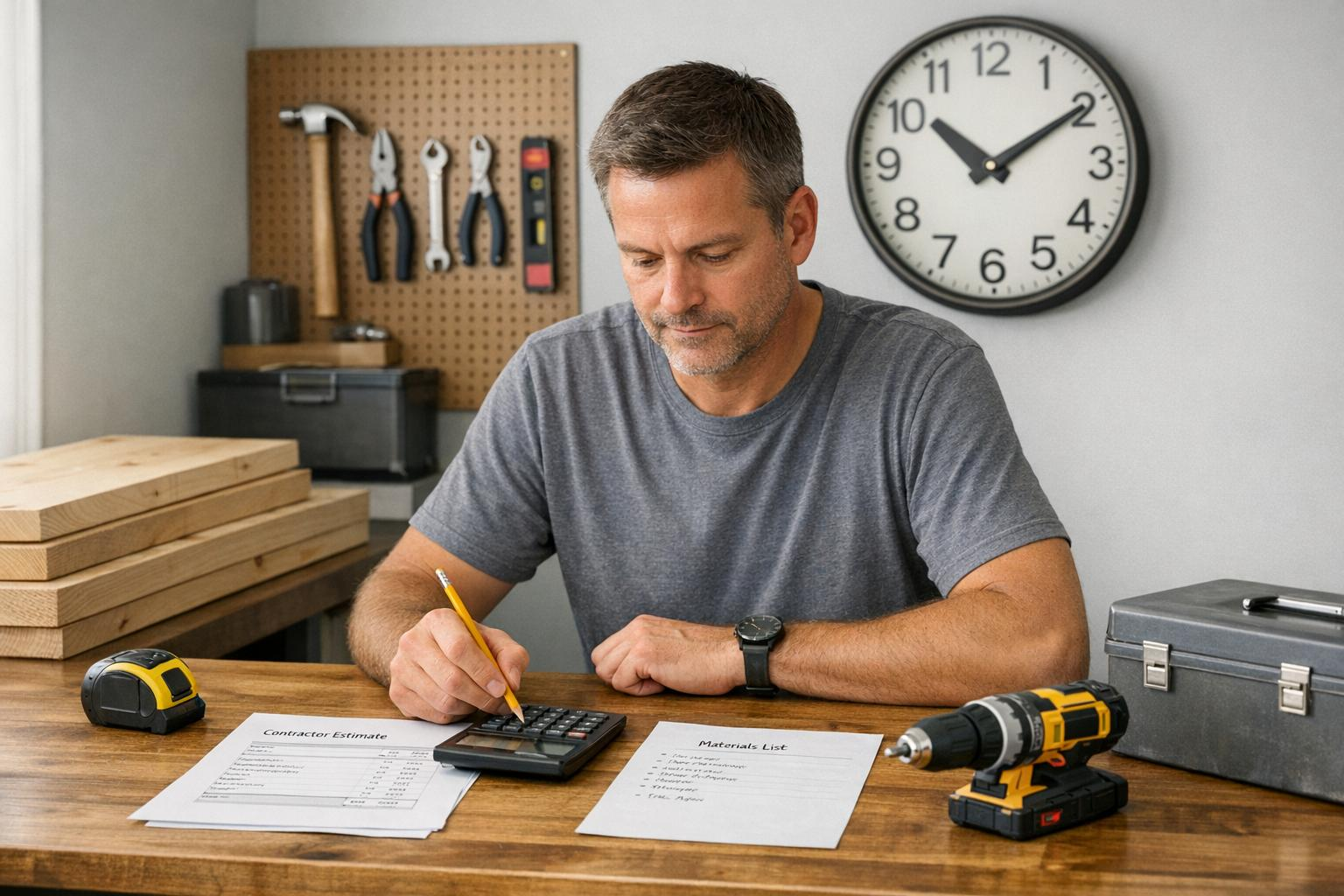
Your time often costs more than DIY savings—calculate your hourly value before starting any home project.
DIY projects can save you money, but they often cost more time than expected. Here’s the bottom line: When deciding to DIY or hire a professional, you need to calculate the value of your time. If your time is worth more than the savings from DIY, hiring a pro might be smarter.
Key insights:
Pro tip: Factor in opportunity costs, skills, and stress levels when deciding. If a project feels overwhelming or takes time away from work or family, hiring a professional may be the better choice.
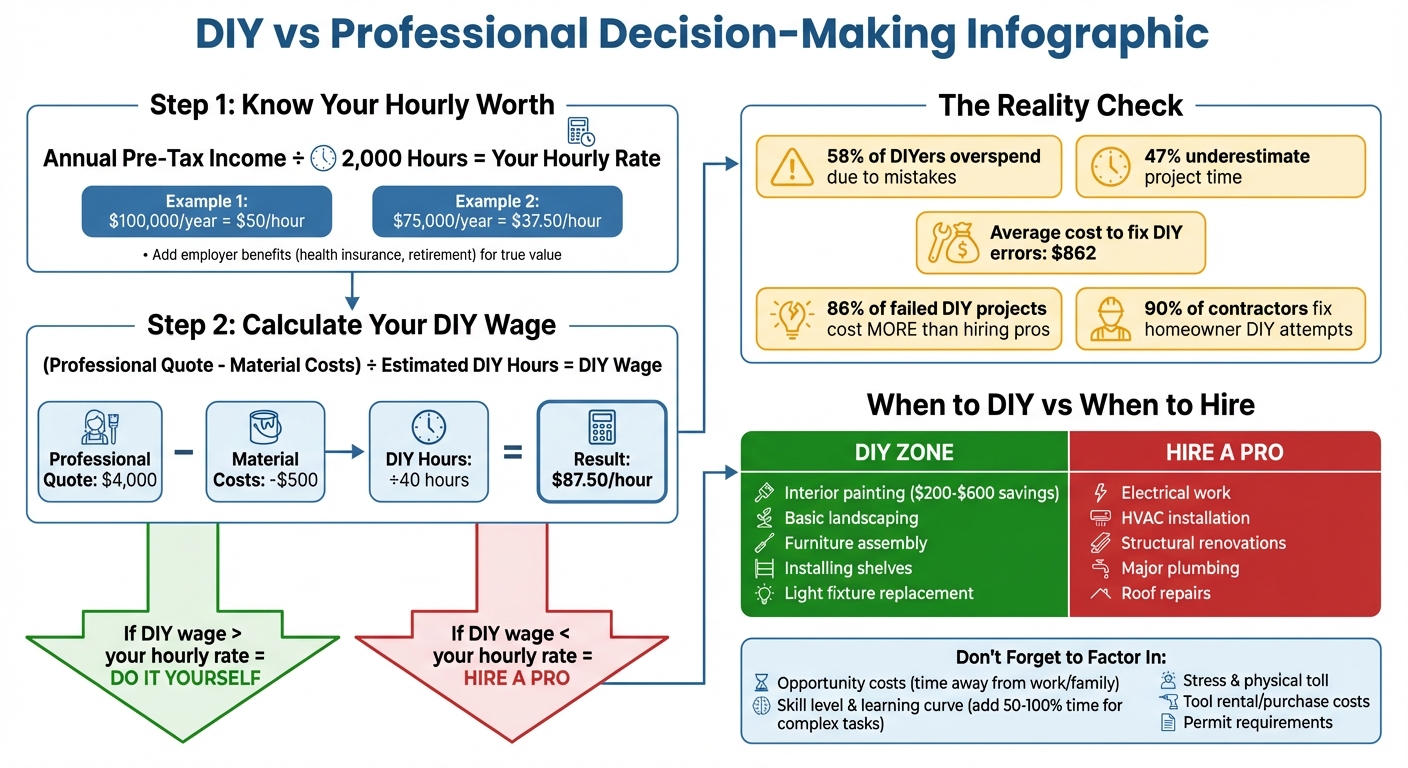
DIY vs Professional Decision Calculator: How to Value Your Time
Figuring out the value of your DIY time starts with knowing your baseline hourly rate. To calculate this, divide your annual pre-tax income by the total number of hours you work in a year. For example, a full-time job with two weeks of vacation typically adds up to about 2,000 working hours annually. So, if your annual income is $100,000, your baseline hourly rate is approximately $50. If you make $75,000, your rate would be closer to $37.50 per hour.
Once you know your baseline rate, use it to decide whether a DIY project makes financial sense. Here’s a simple formula to calculate your "DIY wage":
(Professional Quote – Material Costs) ÷ Estimated DIY Hours.
For example, if a professional painter quotes $4,000 to paint your house, materials cost $500, and you estimate it will take 40 hours to complete the job yourself, your DIY wage would be:
($4,000 – $500) ÷ 40 = $87.50 per hour.
In this case, if your baseline rate is $50 per hour, doing it yourself offers better value. But if your baseline rate is closer to $100 per hour, hiring the pro might be the smarter move, saving you time and effort.
"Anytime you can take something qualitative (do I feel like doing that?) and make it quantitative (is it worth my time to do that?), it’s easier for your brain to process." – Jim Wang, Founder, WalletHacks
For a more precise calculation, factor in the value of your employment benefits. For instance, if your employer contributes $10,000 annually toward health insurance or retirement, that $100,000 salary effectively becomes $110,000. This adjustment increases your hourly rate, which could influence your decision.
Finally, remember that personal factors like skill level and opportunity costs can further refine how you value your time.
Your baseline rate is just the starting point. Personal skills, commitments, and preferences play a big role in determining the real value of your time.
Your skill level can significantly impact how efficiently you complete a project. Professionals work faster and with fewer costly DIY mistakes, which is why handyman rates range from $30 to $125 per hour. If a pro can finish a job in 2 hours but it takes you 6, the value of your DIY time drops. For complex tasks, add 50%–100% to your time estimate to account for the learning curve and potential rework.
Opportunity cost is another factor to consider. What are you giving up to tackle a DIY project? Chris Bailey, author and productivity expert, explains:
"The value [of time] will orbit around four things: how frugal you are, how much you value your time, your income, and how busy you are or how overwhelmed you feel."
If you’re juggling work, family, or other commitments, your free time might feel twice or even three times as valuable as your calculated rate. On the other hand, if you have plenty of downtime or are between jobs, the value of your DIY time may be lower because you’re not sacrificing as much.
Lastly, consider the emotional and physical toll of a project. If a task feels stressful or overwhelming, it carries a hidden cost. For example, if you love gardening, the time spent might feel rewarding, even if the financial savings are modest. But if you dread painting and it leaves you drained, the stress might outweigh any money saved. Balancing these factors is key to making the right decision.
Keeping track of your hours is key to understanding how much you’re saving by going the DIY route compared to hiring a pro.
Using a timer app or a simple notebook works well for tracking your time. Start the clock when you begin working and stop it when you’re done, or jot down your start and end times in a notebook you keep handy in your workspace.
Break your time into categories to see where your efforts go. Direct labor includes hands-on tasks like cutting wood, painting, or installing fixtures. Incidental labor covers things like trips to the store, setting up your workspace, or cleaning up afterward. Don’t forget to include time spent researching or planning, as these steps are part of the process too.
It’s smart to add a buffer to your time estimates. For straightforward projects, tack on an extra 15% to 25%. For more complex or unfamiliar jobs, increase that buffer to 30% to 50%. This cushion helps account for unexpected delays like bad weather, tool issues, or mid-project adjustments.
By keeping detailed time logs, you’ll have the information you need to calculate accurate labor costs.
To figure out your labor cost, multiply the total hours you worked by your hourly rate. For example, if you spend 30 hours building a deck and value your time at $50 per hour, your labor cost comes out to $1,500.
Next, compare this number to what a professional might charge. Use this formula to see your potential savings:
(Professional Quote – Material Costs) ÷ Total DIY Hours = Your Hourly Savings.
Here’s an example: A contractor quotes $5,000 for a deck, and your material costs are $2,000. Using the formula:
($5,000 – $2,000) ÷ 30 ≈ $100 per hour.
That $100 hourly savings is double your $50 hourly rate, showing how DIY can pay off when you assess your time’s worth.
Understanding your own hourly rate is a big part of making this comparison. Professional rates in 2026 typically range from $18 to $28 per hour for general labor, $42 to $48 per hour for handymen, and $45 to $72 per hour for licensed trades like electricians or plumbers. Labor usually makes up 50% to 70% of a pro’s total bill, so DIY can be especially rewarding for high-labor, low-skill projects.
"Labor is one of the most difficult costs to predict in an estimate." – Shawn McCadden, President, Custom Contracting Inc.
Looking back at past projects can help refine your future estimates, combining real-world experience with calculated savings. This approach connects the time you invest directly to financial outcomes, making it easier to weigh the DIY vs. professional decision.
For more detailed tips and advice on managing your DIY project time and costs, check out the guides at Gold Team Home.
Figuring out whether to tackle a project yourself or hire a professional often comes down to cost. The breakeven point happens when your DIY expenses (materials and labor) match what a professional would charge. To calculate this, multiply the hours you expect to spend on the project by your hourly rate, then add material costs. If the total equals or surpasses the professional quote, it’s likely worth hiring someone.
Here’s a breakdown of typical projects:
| Project Type | DIY Material Cost | Pro Total Cost | DIY Hours Needed | Your Rate to Break Even |
|---|---|---|---|---|
| Interior Painting (Room) | $100–$200 | $300–$800 | 8–12 hours | $8–$58/hour |
| Vinyl Plank Flooring (200 sq ft) | $400–$600 | $1,000–$1,600 | 12–16 hours | $25–$63/hour |
| Deck Building | $1,500–$4,000 | $4,000–$10,000 | 40–60 hours | $0–$100/hour |
| Bathroom Upgrade | $5,000–$8,000 | $15,000–$30,000 | 80–120 hours | $58–$183/hour |
Keep in mind the hidden costs, like tool rentals, permits, and disposal fees, which can push your DIY expenses higher than expected. Plus, mistakes can be costly – 86% of DIY projects that require professional fixes end up costing more than initially planned, with homeowners spending an average of $862 to correct errors.
"With each project you are thinking of attempting, figure out what could likely go wrong and the resulting risk and cost. If that number is more than you are willing to pay, hire someone instead." – Professional Service Person
Once you’ve assessed the risks and costs, you can better decide which projects are worth doing yourself and which are better left to the pros.
For simpler tasks with a low learning curve, DIY can save you a good chunk of change. Take interior painting as an example: hiring a professional costs $300 to $800 for a standard room, while DIY materials are only $100 to $200. That’s a potential savings of $200 to $600. Other straightforward projects like assembling furniture, installing shelves, or basic landscaping (think mulching or planting) are also great for DIY. These tasks don’t require specialized tools or extensive knowledge, making them accessible for most homeowners.
Another example is replacing a light fixture on an existing electrical box. This manageable project can save you the $100 to $200 service fee a professional might charge – just remember to turn off the breaker first for safety.
When it comes to high-risk or highly technical work, hiring a professional is usually the safer and smarter option. Jobs like major electrical work, HVAC installation, and structural renovations not only require permits but also demand specialized skills and strict safety standards. Attempting these projects without expertise can lead to accidents or costly damage – 11% of homeowners have caused safety hazards or injuries during DIY attempts on advanced projects.
Other complex tasks, like intricate tiling with ceramic or natural stone, roof repairs, or major plumbing modifications, are also best left to experts. For instance, a small plumbing mistake, such as a hidden leak, can result in thousands of dollars in water damage. And with 90% of contractors reporting they’ve been hired to fix or finish a homeowner’s DIY attempt, it’s clear that professional help can save money in the long run.
"The cost to have a job done right once is often less than having the lowest bid done over again several times." – Nicole Harris Bocianski, Staff Writer, Angi
For mid-range projects, consider a hybrid approach. You can handle simpler tasks like demolition, painting, or cleanup yourself, and bring in professionals for technical work like electrical, plumbing, or precision tasks. This way, you save on labor for the easier parts while ensuring the complex components are done correctly. Striking this balance can help you get the best of both worlds – saving money where you can while avoiding costly mistakes.
Taking the time to read through your project plan before diving in can save you from a lot of frustration later. Many DIYers rush into cutting or assembling, only to realize they’ve skipped crucial steps along the way. Watch the entire tutorial video or carefully review the instructions to get a clear picture of the process and spot potential challenges ahead of time.
Before you even begin, make sure you have everything you’ll need. Create a detailed inventory of tools and materials, and consider buying 10–15% more material than the plan calls for. This extra cushion helps account for defects like knots in wood or accidental cutting mistakes. As you prepare, label parts as you cut them and sand individual pieces before assembly. Once parts are fastened together, accessing all surfaces becomes much more difficult.
Once your plan is set, having the right tools can make all the difference in streamlining your work.
Using the right tools doesn’t just make your project easier – it can save you a ton of time. Labor is the largest expense in most home repairs, making up the bulk of costs in 9 out of 10 cases. For example, a brushless cordless drill provides smoother cuts and faster assembly, without the hassle of battery issues or motor stalls. Similarly, an oscillating multitool can handle precise trimming jobs and reduce the need for rework.
If you only need a specialized tool for a one-time task, renting is often the smarter choice to avoid unnecessary costs. However, for essential tools like drills, work lights, or stud finders, investing in high-quality versions is worth it. For instance, a professional-grade 13-sensor stud finder, priced at $52.95, can save you from creating unnecessary holes and causing drywall damage.
Once you’ve got the tools squared away, relying on trustworthy resources can further improve your efficiency.
Not all online tutorials are created equal. Many skip over critical details, assuming the viewer has advanced knowledge. A quick 10-minute video might leave out important factors like local building codes, hidden wiring, or plumbing systems behind your walls. This lack of detail often leads to mistakes, which is why 90% of professional contractors are called in to fix DIY projects gone wrong.
Trusted sources, like Gold Team Home, offer guidance that fills in the gaps most tutorials miss. They address often-overlooked steps such as setting up materials, staging your workspace, and cleaning up afterward. Using a centralized planning tool can also help you track tasks, hours, and material costs, reducing the risk of overspending – a common issue in 86% of DIY projects.
"Before you start the project, do some research… to make sure you have the time and the tools required for the project." – Homeowner Survey Respondent, Angi
Choosing between tackling a project yourself or hiring a professional comes down to understanding how much your time is worth. To figure this out, calculate your hourly rate by dividing your annual pre-tax income by the total hours you work in a year. Then, compare it to your potential DIY "wage" – calculated as the difference between the professional quote and the cost of materials and tools, divided by the estimated hours you’ll spend on the project. If your DIY rate ends up lower than your regular earnings, outsourcing might make more sense.
But it’s not just about numbers – your life circumstances play a big role too. If you’re juggling work, family, and other commitments, your free time may be too valuable to spend on DIY tasks, even if they save you money. On the flip side, if you have extra time and enjoy learning new skills, taking on a project yourself can be satisfying, even if the financial payoff is smaller.
For projects with higher stakes – like electrical work, plumbing, or structural changes – it’s usually smarter to leave it to the experts. Statistics show that 86% of DIY projects requiring professional fixes end up costing more than planned, with homeowners spending an average of $862 on additional expenses. To avoid these pitfalls, save your DIY efforts for simpler tasks like painting or basic landscaping, where mistakes are easier to fix.
Also, consider how else you could use your time. Those hours spent on DIY could be used to earn extra income, relax, or enjoy time with loved ones. Lauren Bowling from Financial Best Life emphasizes this point:
"Knowing the value of your time is crucial… it helps me in everyday decisions both big and small".
Before committing to any project, get a professional quote, check your tools, and make sure the time investment aligns with your schedule. The key is to weigh your time’s value against your lifestyle and the challenges of the project.
To estimate the time for your DIY project, start by breaking it down into smaller, specific tasks. Assign a realistic amount of time to each step, and don’t forget to add some extra time as a buffer for unexpected delays. A detailed plan will help you stay on track and make adjustments as needed. By carefully planning, accounting for interruptions, and learning from the actual hours you spend on tasks, you can get better at predicting how long future projects will take and avoid running out of time.
When planning a DIY project, it’s important to think beyond just the cost of materials. There are often hidden expenses that can catch you off guard. For instance, you might need to pay for permits, which can range anywhere from $50 to over $2,000 depending on the project and location. Then, there’s the cost of tools – some of which you might only use once.
Don’t forget about unexpected costs like fixing mistakes or even hiring professionals to correct something that didn’t go as planned. And while money is a big factor, time costs are just as critical. Delays, lost wages from taking time off, and the stress of juggling everything can add up quickly.
Being mindful of these factors can help you figure out whether tackling the project yourself is actually cost-effective – or if bringing in professionals might save you more in the long run.
Taking on DIY projects can be tempting, but they’re not always the best choice – especially when they go beyond your expertise, involve safety risks, or demand specialized tools and knowledge. For example, tackling electrical work, plumbing, or structural modifications without proper skills can result in safety hazards, expensive repairs, or even legal troubles if mistakes are made. When the risks, time investment, and potential costs outweigh the money you might save, it’s usually wiser to bring in a licensed professional.